A new approach for project portfolios.
An approach following the principles of Theory of Constraints.
Regain control over portfolios
Organizations do not fall behind because they lack ambition.
They fall behind because their projects deliver too little value.
And that rarely happens because they choose the wrong projects. More often, the opposite is true. They have too many good projects.
The organization becomes overloaded. Projects compete for the same people. Work stalls. Staff multitask. Delivery slows down. Projects get delayed, become inefficient, or fail altogether.
The damage does not stop there. The overload also undermines mid-term portfolio planning and weakens the effectiveness of strategic choices. Decisions are made based on plans that the organization cannot realistically execute.
What makes the situation persistent is that every attempt to improve it tends to add complexity. New governance layers, new planning tools, new prioritization exercises. Yet the underlying workstreams remain congested.
As long as that congestion is not addressed, the portfolio will continue to jam.
Workstream-Driven Portfolio Management
Workstream-Driven Portfolio Management offers a practical way to restore control.
It helps project-driven organizations steer the deployment of their people, prevent overload, and establish a reliable portfolio production plan.
And it does so without requiring detailed schedules for every project, without heavy administrative overhead, and without a major reorganization.
For a director, the promise is simple.
You gain a clear view of what your organization can actually deliver, when it can deliver it, and what must change to improve throughput and reliability.
What organizations usually ask for
When organizations ask for portfolio management, they usually ask for prioritization frameworks, capacity overviews, dashboards, governance structures, resource planning, escalation processes, portfolio calendars, and reporting. They ask for these things because they want control, predictability, and a stronger link between strategy and execution.
That desire is valid. But it is not where portfolio management should start.
Organizations do not primarily need a better list of projects.
A better starting point is to restore the flow of projects that have already been planned or are already in execution.
What leaders truly need is not portfolio management as an administrative discipline. They need a system that makes execution reliable again.
Their real concern is simple: fewer surprises, fewer broken promises, less overload, and more confidence that when they say “yes” to a strategic initiative, the organization can actually deliver it.
The weakness of traditional frameworks
Common frameworks advise beginning with selection, prioritization, and governance. These things matter. And don't stop doing it when you already have it in place and when you're happy about it. But don't start your implementation with it before getting stalled projects moving again and preventing new projects from jamming the system in the future.
When the root cause of portfolio congestion is not addressed, then the root cause of sub performing portfolios is not addressed. Organizations remain structurally overloaded. Planning conflicts persist and work in progress keeps accumulating. When too many projects compete for the same people, the outcome is predictable: projects wait, staff multitask, delivery slows down, and the portfolio loses predictability.
By trying to solve the wrong problems first, organizations can spend years discussing portfolio management and still lack the basics: a trustworthy overview of ongoing work, a realistic plan for what should start next, and clarity about where people should focus.
The portfolio is treated as a list of initiatives. In reality, it behaves like a system of interdependent workstreams constrained by capacity.
A different approach: treat the portfolio as a system
Workstream-Driven Portfolio Management starts from a different premise.
A portfolio is not just a collection of projects.
It is an independent production system with its own behavioral rules, largely independent of the specific projects or the people involved.
Once you look at the portfolio this way, the control problem changes. The central question is no longer “How do we improve individual projects?” but “How do we manage the portfolio as a system?”
That shift matters.
It makes it possible to improve throughput and predictability by managing flow, reducing overload, and controlling when projects start—rather than endlessly refining plans for individual projects. And it is thousands of times simpler when you no longer have to analyze and reconcile project schedules and personal schedules of people involved. This is a radically different approach.
Workstream-Driven Portfolio Management starts from a different premise.
A portfolio is not just a collection of projects.
It is an independent production system with its own behavioral rules, largely independent of the specific projects or the people involved.
Once you look at the portfolio this way, the control problem changes. The central question is no longer “How do we improve individual projects?” but “How do we manage the portfolio as a system?”
That shift matters.
It makes it possible to improve throughput and predictability by managing flow, reducing overload, and controlling when projects start—rather than endlessly refining plans for individual projects. And it is thousands of times simpler when you no longer have to analyze and reconcile project schedules and personal schedules of people involved. This is a radically different approach.
The heart of the method: the portfolio production plan
At the center of the approach is the portfolio production plan. This is a dynamic portfolio plan in which project start dates and delivery dates are aligned with the productive capacity of the organization as a whole.
It is not just a reporting artifact. It is the core steering instrument for execution. It shows how capacity can be directed to improve the efficiency and productivity of the organization and to support long-term portfolio decisions.
The portfolio production plan supports three connected portfolio processes:
Portfolio realization: steering the projects that are currently in execution.
Portfolio planning: preparing and positioning projects for the medium term.
Portfolio exploration: exploring long-range scenarios and future demand.
Because the speed of workstreams can be measured through actual progress and completion, the production plan becomes a realistic and continuously updated forecast of what the organization can deliver.
It also provides the basis for new commitments and for timely interventions when the portfolio begins to drift out of control.
What makes this approach unique
The uniqueness of Workstream-Driven Portfolio Management is not that it adds another layer of complexity. It reduces complexity. It does so by steering at the level of the portfolio system itself, instead of getting lost in the opaque and often misleading details of individual projects.
Instead of aiming for perfect project plans across the entire portfolio, projects are modeled with a small number of high-level parameters. That is sufficient to understand how a project interacts with the portfolio as a whole, determine when capacity can most reliably be made available, and forecast when projects can be completed.
The result is not a static plan, but a dynamically adapting baseline for steering resource allocation efficiently.
Rather than trying to solve every dependency and every scheduling conflict upfront, the method relies on the actual speed of the workstreams and the behavior around flow control points to determine what is feasible and how the portfolio should be paced.
This has several practical consequences.
It becomes possible to plan realistically based on measured productivity, even without detailed schedules for every project or the names of all the people involved.
It becomes possible to prevent overload by controlling project starts and work in progress, without tracking how many hours individuals spend on each project.
It becomes possible to restore throughput without changing how every individual project manager runs their project.
It becomes possible to maintain reliability and predictability even under the typical uncertainty found in project organizations.
And it becomes possible to give executives one integrated steering view of the portfolio, grounded in actual delivery capacity rather than wishful thinking.
How transformation works
The transformation to Workstream-Driven Portfolio Management is not treated as a one-off implementation. It is a structured change process with a clear progression.
It begins with a gap analysis and the creation of a first portfolio production plan based on the current portfolio and the available capacity. Next, the portfolio process is established, including governance, intake, stage gates, roles, routines, and the portfolio team.
The focus then shifts to portfolio realization, where the daily portfolio routine becomes embedded in the organization. After that comes portfolio planning for the medium term, followed by portfolio exploration for the long term.
This progression matters because portfolio management only works when it is embedded in the actual operating rhythm of the organization.
The transformation to a Workstream-Driven organization is a structured learning curve to developing maturity. It is not about introducing rigid portfolio management processes. Its purpose is to learn in practice how the system works in your own organization while achieving results quickly.
No unnecessary complexity
A key strength of this approach is that it avoids unnecessary burden.
You do not need a large bureaucratic apparatus.
You do not need every project to have a perfect and fully maintained schedule.
You do not need to wait until the organization is “mature enough.”
And you do not need to begin with a new software platform.
High-level capacity estimates, a workable inventory of current and planned projects, and a disciplined focus on workstreams are sufficient to make a practical start.
The method is designed to work under uncertainty, with imperfect data, and in organizations where previous attempts to implement portfolio management have already failed.
No unnecessary complexity
What changes, and what does not
This approach is not about turning project managers into administrators.
It is not about imposing a new, detailed planning burden on all your teams.
And it is not about replacing strategy with mechanics.
Leaders, portfolio owners, and managers be enabled to make better strategic choices, define more ambitious ambitions, with less operational distractions. What changes is that the organization gains a way to reliably execute the choices that are made.
The portfolio production plan becomes the place where ambition meets capacity, and where feasibility becomes visible.
In other words, Workstream-Driven Portfolio Management does not take away managerial responsibility. It makes that responsibility operationally steerable.
Who this is for
This approach is for organizations that depend on projects for their success, run many projects in parallel, and have reached the point where informal coordination no longer works.
It is for organizations that want to stop being driven by overload, urgency, and constant surprises, and instead build a portfolio that can be executed with rhythm, control, and confidence.
If your organization keeps asking for more visibility, more prioritization, more portfolio governance, and more predictability, the real question may be simpler:
Do you want a better administrative portfolio process,
or do you want a portfolio that actually flows?
Contact
If you want to explore what this would mean for your organization, the best starting point is not a software demo or a maturity assessment. It is a direct look at your portfolio as it really behaves today.
We can help you make that visible.
We help project-driven organizations:
• understand where overload and stagnation actually come from,
• build a first portfolio production plan based on real capacity,
• restore flow and predictability,
• and create a practical path toward sustainable portfolio control.
Contact me directly via LinkedIn. My name is Jan van Egmond.

Breakthrough in algorithms for resource planning enables a new straight forward approach for organizations with projects.
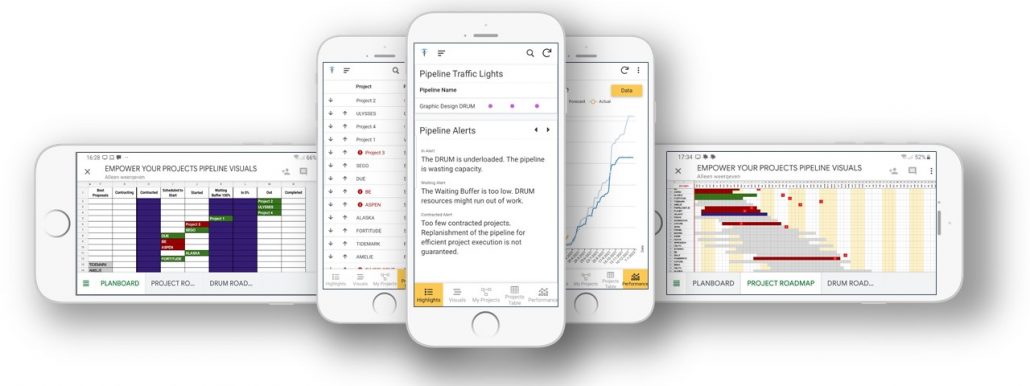
Instead of trying to schedule every single task of every project in the portfolio — assigning resources, balancing workloads, and constantly resolving planning conflicts — Empower Your Projects takes a radically different approach.
If you’ve ever tried traditional planning yourself, you know how impossibly complex, confusing, and contradictory it becomes.
Rooted in the Theory of Constraints and system dynamics, Empower Your Projects adapts algorithms long used to manage the flow of workstreams in production lines and logistics — fields that have mastered series and mass production for decades. Only minor adjustments were needed to make these methods work for large project portfolios with multiple paralll workstreams.
These algorithms don’t require detailed task-level scheduling. Yet, it provides one key output: the right start time for each project. This is enough to maintain continuous flow across the portfolio — without interruptions, without overload, and without gridlock.
It may sound complex — but it turns out to be surprisingly simple.
Getting started is easy
The transformation to a workstream-driven portfolio follows a predictable and executable path and begins with a simple inventory: available capacity, ongoing and already planned projects, and their capacity needs — all visualized in the portfolio production plan.
The portfolio production plan is the perfect instrument to steer the workstreams and portfolio realization, and the workstream planboard to keep track of the relative position of the projects in the workstream is the perfect instrument to keep the dynamics of the portfolio under control. This gets the portfolio flowing smoothly, fast, sufficient for break through results. This is a great way to start.
Planning projects for the mid term keeps the workstreams going without interruption as more projects reach completion. Exploreing strategic directions for the long term helps develop the organization and prepare for projects that have not yet taken shape.
Getting more strategic priorities done starts by completing more projects now. Step by step, the tactical and strategic portfolio processes can then evolve and mature.
Copyright © 2026 Empower Your Projects. All Rights Reserved.